Wine and beer bottle label sizes: how to measure your bottle
There's no single standard size. Measure the straight part of your bottle, then use these rules of thumb for front, back, neck and wraparound labels.
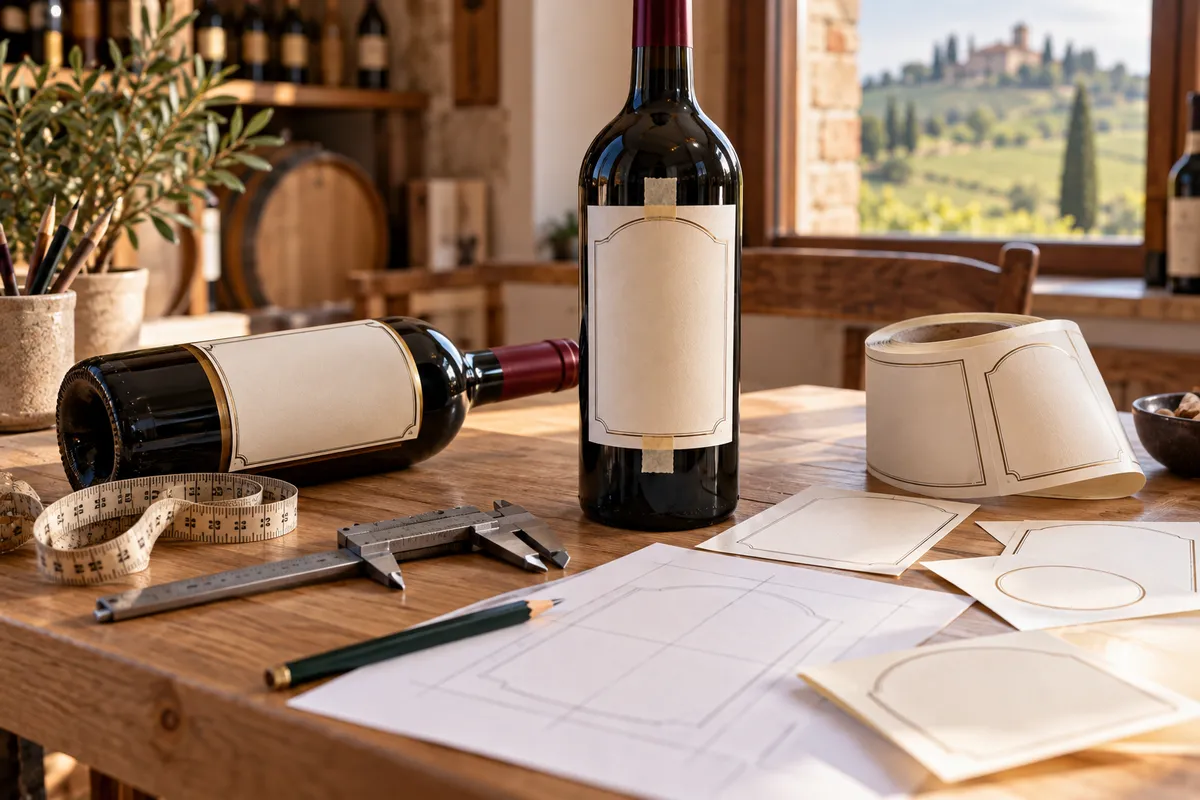
Search "wine bottle label size" and you'll find a dozen different answers, because the right size depends on the bottle. A Burgundy, a Bordeaux and a 500ml ale bottle all have different shoulders and curves. Measure first, then design.
Measure the straight part
With a tailor's tape on an empty bottle, measure:
- the usable height: from about 1–2 cm above the base up to where the shoulder starts to curve;
- the circumference at the point where the label will sit.
A label must stay on the cylindrical part. If it climbs onto the shoulder, it will crease.
Rules of thumb
| Bottle | Typical approach |
|---|---|
| 75cl wine (Bordeaux, Burgundy) | front label on the straight body, back label opposite, gap of glass between them |
| 330ml beer | shorter, wider front label, or a wraparound |
| 500ml beer / ale | taller front label; check the shoulder starts lower on some shapes |
| Gin and spirits | often a front label plus a neck label or seal |
These are starting points, not standards. The only reliable measure is your own bottle.
Front and back labels
Keep a few centimetres of bare glass on each side between front and back labels. As a rule of thumb, both labels together shouldn't cover more than about two-thirds of the circumference. It looks better and helps if you use a labelling machine.
Wraparound labels
For a label that goes all the way round:
width = bottle diameter × 3.14 − 2 to 3 mm
The small gap stops the ends overlapping and lifting. For example, a 66 mm diameter gives a circumference of about 207 mm, so the label would be about 204–205 mm wide. Measure the actual diameter with calipers: bottles of the same model can vary slightly.
Neck labels
Bottle necks are tapered, so a neck collar is curved (an arc), not a rectangle. Ask your bottle supplier for the technical drawing, or make a paper template and adjust it until it sits flat.
Test before you print
Print your design at 100% on plain paper, cut it out and tape it to a real bottle. Look at it from a metre away, the way a customer sees it on the shelf.
Material
For bottles that go in an ice bucket or a fridge full of condensation, choose wet-strength paper or polypropylene. Textured papers, hot foil and embossing give a premium finish. See wine and bottle labels, and our overview of what goes on bottle labels. For printed rolls, tell us the core size and winding direction your labelling machine needs.
FAQ
What size label fits a wine bottle?
It depends on the bottle shape. Measure the usable height of the straight part and the circumference where the label will sit, then design to fit.
How do I calculate a wraparound label?
Width = bottle diameter × 3.14, minus 2–3 mm so the ends don't overlap.
What label material survives an ice bucket?
Wet-strength paper or polypropylene. Ordinary paper labels soften and peel in iced water.