Hazard symbols: the 9 GHS pictograms and what they mean
Red diamond, black symbol: what each of the 9 hazard pictograms means, and the rules for labelling chemicals.
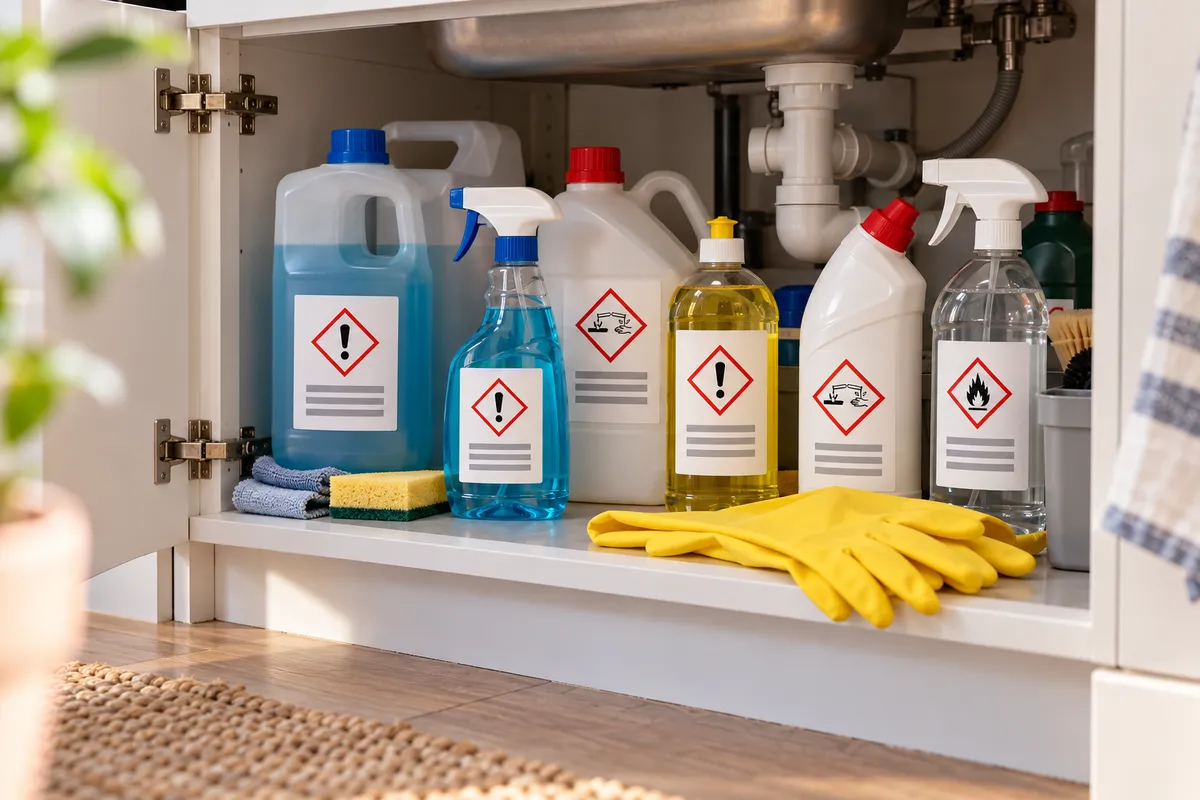
Chemicals sold in Great Britain and the EU carry hazard pictograms in the shape of a diamond: a black symbol on a white background with a red border. They replaced the old orange squares and follow the global GHS system. In the EU that system is applied by the CLP Regulation; Great Britain has its own GB CLP, which uses the same pictograms.
The 9 hazard symbols and their meanings
| Pictogram | Code | Meaning |
|---|---|---|
| Exploding bomb | GHS01 | Explosive |
| Flame | GHS02 | Flammable |
| Flame over circle | GHS03 | Oxidising (can cause or worsen a fire) |
| Gas cylinder | GHS04 | Gas under pressure |
| Corrosion | GHS05 | Corrosive to skin, eyes or metals |
| Skull and crossbones | GHS06 | Acute toxicity, can kill |
| Exclamation mark | GHS07 | Harmful, irritant, sensitising |
| Health hazard | GHS08 | Carcinogenic, mutagenic, toxic to reproduction or organs |
| Environment | GHS09 | Hazardous to the aquatic environment |
One product can carry several pictograms.
What goes on a chemical hazard label
Alongside the pictograms, a CLP label includes:
- the product identifier (name, plus the hazardous substances in a mixture);
- the supplier's name, address and phone number;
- the nominal quantity, for products sold to the public;
- a signal word: "Danger" (more severe) or "Warning";
- hazard statements (H-phrases) and precautionary statements (P-phrases).
Minimum label size
| Pack capacity | Minimum label size |
|---|---|
| Up to 3 litres | 52 x 74 mm where possible |
| 3 to 50 litres | 74 x 105 mm |
| 50 to 500 litres | 105 x 148 mm |
| Over 500 litres | 148 x 210 mm |
Each pictogram must cover at least 1/15 of the minimum label area, and never less than 1 cm². Rules on minimum font sizes have also been added in the EU's 2024 revision of CLP, so check when they apply to your products and whether GB rules differ.
A label that has to last
A hazard label has to stay readable and stuck on for the product's whole life, even if the product drips onto it. Paper often isn't enough. Polypropylene or polyethylene with a protected print copes much better with solvents, oils and damp. For batch numbers and dates printed on site, thermal transfer with a resin ribbon lasts longer than direct thermal.
We print GHS hazard labels on a roll, with pictograms, on chemical-resistant film. For a quote, use our quote request.
FAQ
How many hazard symbols are there?
There are 9 GHS pictograms, from GHS01 (explosive) to GHS09 (environment).
What's the difference between 'Danger' and 'Warning'?
They are the two signal words. 'Danger' is used for the more severe hazard categories, 'Warning' for the less severe ones.
What material should a chemical label be?
A polypropylene or polyethylene film with a protected print, so it resists solvents, oils and damp.