How to tell a genuine hologram from a fake
Holograms are the first thing many brands reach for when copies appear. What they really protect, how to check one, and where they fall short.
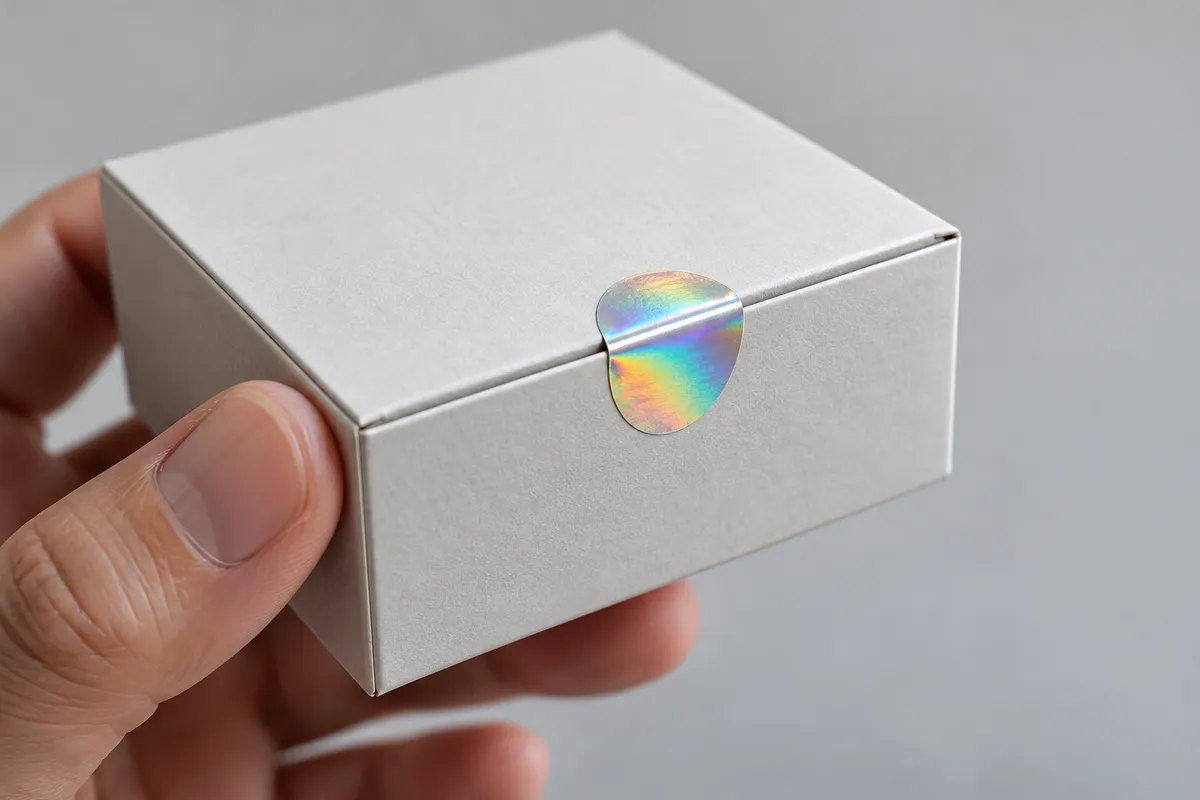
As soon as copies of a product start turning up, every brand asks the same question: how does a customer know they're holding the real thing? A hologram sticker is often the first answer, and for good reason.
Why holograms are hard to fake
A hologram isn't printed like an ordinary picture. The design is formed by a microstructure that reflects light differently depending on the angle. Tilt the sticker and the colours shift, shapes appear, or parts of the image seem to move in depth.
An inkjet or laser printer can't reproduce that. At best it prints a silvery design that looks similar from a distance but stays flat and doesn't change in the light – and a customer can spot the difference in a couple of seconds.
How a customer checks a hologram
- Tilt it. The colours should change clearly and smoothly.
- Look for depth. On a good hologram, some elements appear to sit in front of or behind others.
- Find a specific detail. Micro-text, a logo or a fine pattern – provided the brand has told people what to look for.
That last point gets overlooked. A hologram does little if nobody knows what the genuine one looks like, so put a reference photo on your website or in the instructions.
Standard or custom hologram?
A standard hologram with a generic design (often with words like "original" or "genuine") is available straight away. It shows that checks are in place and deters casual tampering.
A custom hologram carries your logo or your own pattern. That's what really protects against counterfeits, because a forger can't simply buy it off the shelf.
Make it stronger: VOID, numbering, QR codes
A hologram proves authenticity, not opening. So it's often combined with:
- a VOID effect, which leaves a trace if the sticker is peeled off to be reused on a fake;
- a sequential number that customers or resellers can check;
- a QR code linking to a verification page.
Where to put it
Across the closure of the box or bottle, so it doubles as an authenticity mark and a tamper seal. On equipment, next to the rating plate or over a case screw.
No protection is unbreakable, but a well-designed hologram makes copying noticeably more expensive and easier to spot. Our hologram labels come as standard stock designs or fully custom; for a VOID version, see our security labels and the guide to VOID and hologram labels.
FAQ
Can hologram stickers be copied?
Not on an ordinary printer. Organised counterfeiters can produce something similar, which is why a custom design plus a checkable feature such as a number is worth having.
What's the difference between standard and custom hologram stickers?
Standard holograms use a generic design and are available immediately. Custom ones carry your logo or pattern and are what really protect the brand.
Does a hologram sticker show whether a product has been opened?
Not on its own. That needs a VOID effect or a destructible material, both of which can be combined with a hologram.