What is an SSCC? Reading the 18 digits and getting the pallet label right
The SSCC is the only mandatory element on a GS1 logistic label, yet it causes more goods-in queries than anything else on the pallet. Structure, layout, placement and the usual mistakes, with the numbers from the standard.
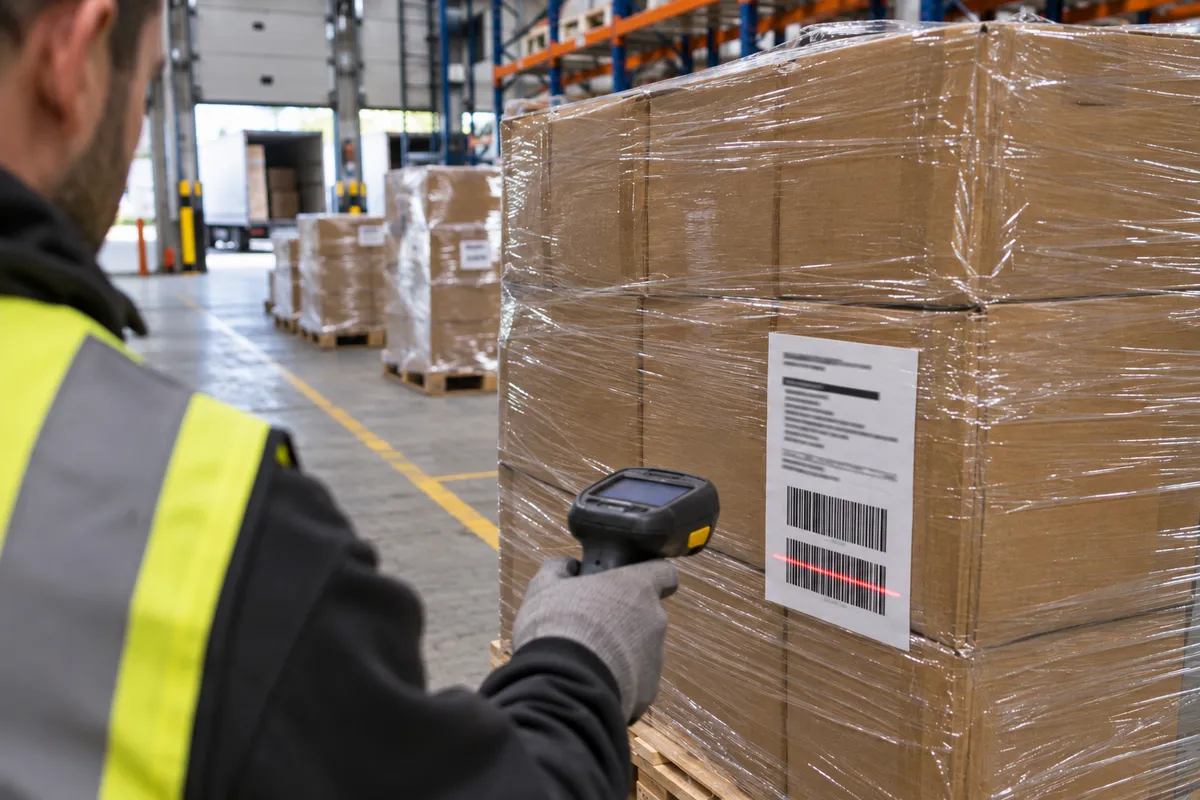
When a pallet gets held at goods-in, it is rarely the product. Usually it is the label: a barcode that won't scan, an SSCC that doesn't match the ASN, a label buried under stretch wrap. This is what the GS1 standard actually asks for, and what goes wrong on real loading bays.
What an SSCC is (and isn't)
The SSCC (Serial Shipping Container Code) identifies one specific logistic unit: this pallet, not the product on it. Two identical pallets of the same line carry two different SSCCs. Under the GS1 Logistic Label Guideline it is the only mandatory element on the label; everything else is agreed with your customer.
It is encoded in a GS1-128 barcode after Application Identifier (00), followed by 18 digits:
| Position | Content | Purpose |
|---|---|---|
| 1 | Extension digit (0–9) | Extends the number range; your choice |
| 2 to 8 (or more) | GS1 company prefix | Licensed by GS1 UK to the company that builds the pallet |
| then | Serial reference | Allocated in sequence: …0001, …0002 |
| 18 | Check digit | Modulo 10 calculation |
Prefix and serial reference always add up to 16 digits. A common misunderstanding: the prefix makes the number unique worldwide, but it does not show where the goods come from.
Worked example: the check digit
A fictitious SSCC: extension digit 3, company prefix 5012345, serial reference 000000318. The first 17 digits are 3 5012345 000000318. Multiply alternately by 3 and 1 starting from the left, add them up (total 75), and take the difference to the next multiple of ten: 80 − 75 = 5.
Under the bars you print (00) 3 5012345 000000318 5. The brackets appear in the human-readable line only; they are never encoded in the barcode.
The three blocks of the label
The standard splits the label into three blocks, top to bottom:
- Top, free format: sender, consignee, logo. Text at least 3 mm high.
- Middle: the same data as the barcodes in plain text, with data titles in CAPITALS (SSCC, CONTENT, COUNT, BEST BEFORE…), characters at least 7 mm high. If no language has been agreed, use the English data titles.
- Bottom, the only mandatory block: one or more GS1-128 barcodes with their human-readable line (at least 3 mm).
Three rules in that bottom block catch out a lot of home-made labels:
- the SSCC always goes in the lowest barcode;
- it must be a genuine GS1-128, with the FNC1 character straight after the start character. A plain Code 128 that happens to start "00…" won't be read as an SSCC;
- bars run vertically (picket fence), never ladder orientation on a logistic unit.
Barcode dimensions that matter
On logistic labels the GS1-128 module width (X-dimension) is between 0.495 and 0.94 mm, with 0.495 mm as the target. Bars are at least 31.75 mm high (not counting the text) and the quiet zone on each side is at least 10 times the X-dimension.
An SSCC on its own (20 digits including the "00") comes to 156 modules. At 0.5 mm that is 78 mm of bars, about 88 mm with quiet zones, so it fits a 100 or 105 mm wide label. At 0.94 mm you would need more than 16 cm, which is why large modules belong on A5 labels and in harsh conditions such as cold stores.
On a 203 dpi printer one dot is 0.125 mm: set the module to 4 dots (0.50 mm). At 300 dpi, 6 dots give 0.508 mm. A module that falls between two dots prints uneven bars that fail verification.
The right format
The GS1 guideline names two common formats: A6 (105 × 148 mm) or 4 × 6 inch when the label carries only the SSCC or a little data, and A5 (148 × 210 mm) when trade item data is added. The 100 × 150 mm used by most shipping printers is the metric equivalent of 4 × 6 inch. On an A6 label the SSCC must not be concatenated with other data in the same barcode.
Where the label goes on the pallet
- Barcode 400–800 mm from the base of the pallet; on pallets lower than 400 mm, as high as possible.
- The barcode, including its quiet zones, at least 50 mm from any vertical edge.
- Ideally two identical labels on two sides, so one is always visible. The guideline notes that the right-hand side of each face suits forklift drivers best, as most are right-handed.
When pallets are stacked and wrapped together, each keeps its own SSCC and the whole stack gets an additional SSCC on a master label on the outside of the wrap.
Mistakes that show up at goods-in
- SSCCs built on a service provider's prefix (online label tools): GS1 calls this incorrect use, and traceability leads back to the wrong company.
- Reused numbers: an SSCC must not be reallocated within one year of shipment, and never in healthcare.
- AI (02) together with AI (01): not allowed. AI (02), the GTIN of the cases on the pallet, is used only with the SSCC and AI (37) for the count.
- Data in the barcode but not in plain text, or the same AI twice on one label.
- Label under the wrap, in a fold or across a corner, creased when applied.
- Paper that darkens with heat or sunlight: the GS1 guideline says to avoid heat-sensitive materials. For long storage, outdoor yards or cold stores, thermal transfer is the safer choice (see direct thermal or thermal transfer).
- SSCC on the label differs from the ASN (DESADV): scan the pallets actually loaded, not the ones planned.
What to tell your label supplier
- format (100 × 150, A6 or A5) and labels per roll;
- printer and print method: direct thermal or thermal transfer;
- core size and the maximum roll outside diameter (see label core and winding);
- material: paper, or polypropylene for damp, cold and long storage;
- adhesive suited to stretch film and the temperature at application.
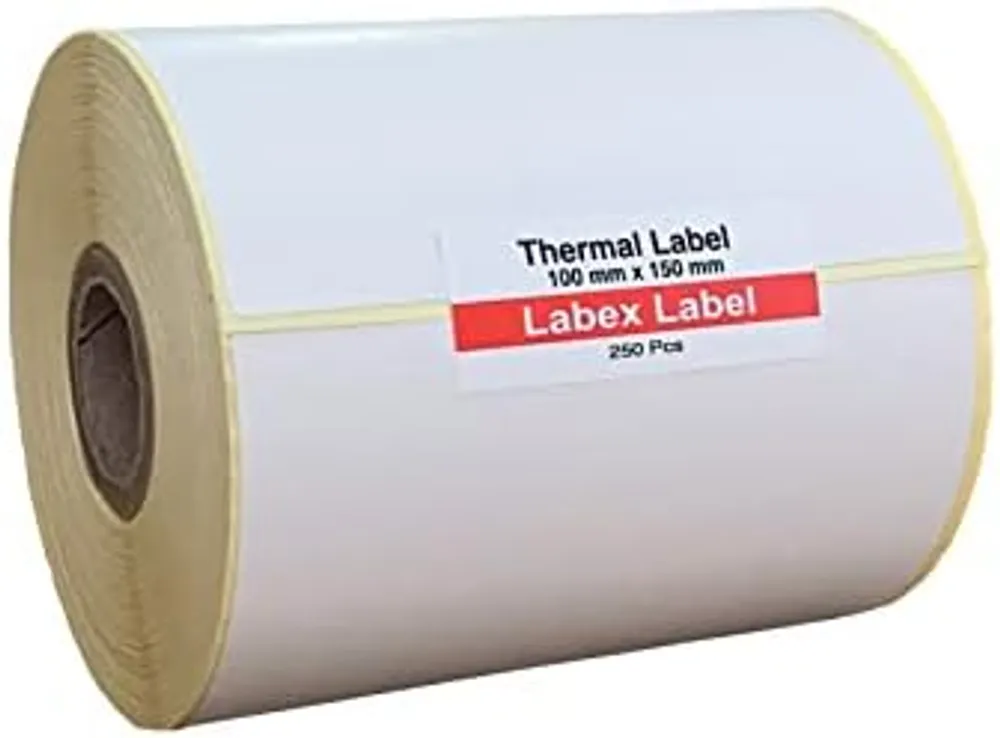
For day-to-day despatch, our thermal labels in 100 × 150 mm on a 40 mm core suit desktop printers. For long storage or cold conditions there are our blank thermal transfer rolls in coated paper and polypropylene, and we produce PP in the size you need.
The figures above follow the GS1 Logistic Label Guideline. Many retailers have stricter supplier manuals, so check yours with the customer or with GS1 UK.
FAQ
Is an SSCC a legal requirement on pallets?
Not as a general legal rule. But once a customer works with GS1 logistic labels, the SSCC is the one element the label must carry, and most retailers and 3PLs write it into their supplier requirements.
Can I create SSCCs without GS1 UK membership?
No. An SSCC is built from your own GS1 company prefix. Using a software or logistics provider's prefix is, in GS1's words, incorrect use of the standard.
What is the difference between an SSCC and a GTIN?
A GTIN identifies a product – every identical case carries the same one. An SSCC identifies one particular pallet or parcel and isn't reused for at least a year.
Can I add a QR code or Data Matrix to the label?
Yes, as an extra: a GS1 2D code can sit to the right of the text in the middle block. The GS1-128 remains mandatory.
Is a direct thermal label good enough?
For pallets delivered within a few days, usually yes. For long storage, sunlight or heat, GS1 advises against heat-sensitive materials, and thermal transfer is the safer option.