Rating plates: what has to go on them and which material lasts
A rating plate stays with a machine for its whole life. What the rules require on it, what customers and service engineers look for, and how to choose a label that stays readable.
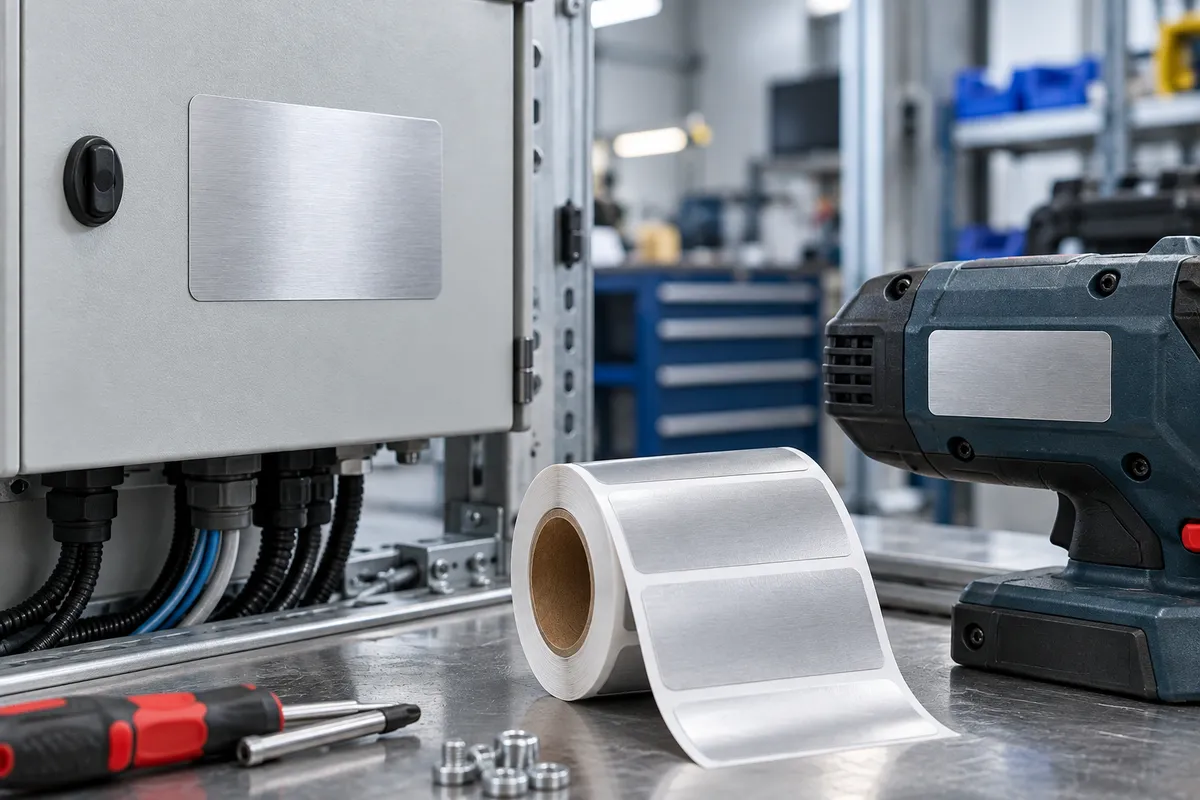
A rating plate is a machine's ID card. People check it at goods-in, during servicing, when ordering spares and at inspections. A plate that's unreadable after two years wastes everyone's time and can become a compliance problem.
What machinery rules require
For machinery placed on the EU market, Directive 2006/42/EC (Annex I, section 1.7.3) requires at least:
- the business name and full address of the manufacturer and, where applicable, its authorised representative;
- the designation of the machinery;
- the CE marking;
- the designation of series or type;
- the serial number, if any;
- the year of construction, meaning the year the manufacturing process was completed.
Regulation (EU) 2023/1230, which replaces the Directive from 20 January 2027, carries the same information over. In Great Britain the Supply of Machinery (Safety) Regulations 2008 apply, with UKCA or CE marking. Check the rules that apply to your product and its date of placing on the market.
What gets added in practice
- electrical data: voltage, frequency, current or power, according to the standards that apply to the equipment;
- the mass, where it matters for handling;
- a barcode or Data Matrix carrying the serial number, for traceability and service;
- sometimes a QR code linking to the manual or spare parts list.
Which material
| Environment | Recommended material | Printing |
|---|---|---|
| Clean indoor use, control cabinet, office equipment | Silvermat (matt silver PP) | Thermal transfer wax-resin or resin, or flexo |
| Workshop: oil, cleaners, abrasion | Polyester | Thermal transfer with resin ribbon |
| High heat, aggressive substances, long-term outdoors | Validate with a test on the part | According to the test |
Silvermat gives a brushed-metal look without glare, popular on technical products. Polyester is stiffer and tougher, and the choice once oil, solvents or heat are involved. The full comparison is in paper, PP or polyester.
Serial numbers: pre-printed or printed on site?
- Pre-printed: we produce labels with sequential numbering, delivered in order. Ideal for large runs.
- Printed on site: a Silvermat or polyester base with logo and fixed fields, with a thermal transfer printer adding serial number, date and barcode at assembly. Ideal when each machine has different data.
Warranty and tamper evidence
To show unauthorised opening, a VOID label leaves a visible pattern when removed. It complements the rating plate rather than replacing it (see our security labels).
Common mistakes
- A plate on a hot or vibrating surface without a suitable adhesive.
- A wax ribbon on PP: it wipes off at the first clean.
- Year of construction or address left off.
- A barcode too small for the workshop scanner.
What to tell your supplier
- environment (oil, heat, cleaners, outdoors);
- application surface (painted metal, plastic, bare aluminium);
- fixed and variable fields;
- printer and ribbon if you print on site;
- quantities and any numbering.
Our Silvermat silver labels come blank or printed in multi-colour UV flexo; for a custom run, send us a quote request.
This article summarises the rules as of its update date; check the regulations that apply to your equipment.
FAQ
What must go on a machine rating plate?
Under the Machinery Directive: manufacturer and address, designation, CE marking, series or type, serial number if any, and year of construction.
Silvermat or polyester?
Silvermat for clean indoor use; polyester with a resin ribbon once oil, solvents or heat are involved.
Can plates be numbered in advance?
Yes, we produce labels with sequential numbering.
Which ribbon for printing plates on site?
Wax-resin on Silvermat indoors; resin on polyester, or wherever the plate will be cleaned or stressed.
Does the new Machinery Regulation change the information?
Regulation (EU) 2023/1230, applying from 20 January 2027, keeps the same basic information. Use the text in force when the machine is placed on the market.