How to label decanted chemicals at work: secondary containers, pipes and stores
The drum arrives from the supplier correctly labelled. The trouble starts with the first decant. What the rules ask for on wash bottles, workshop containers and pipework, and how to choose a label that survives solvents.
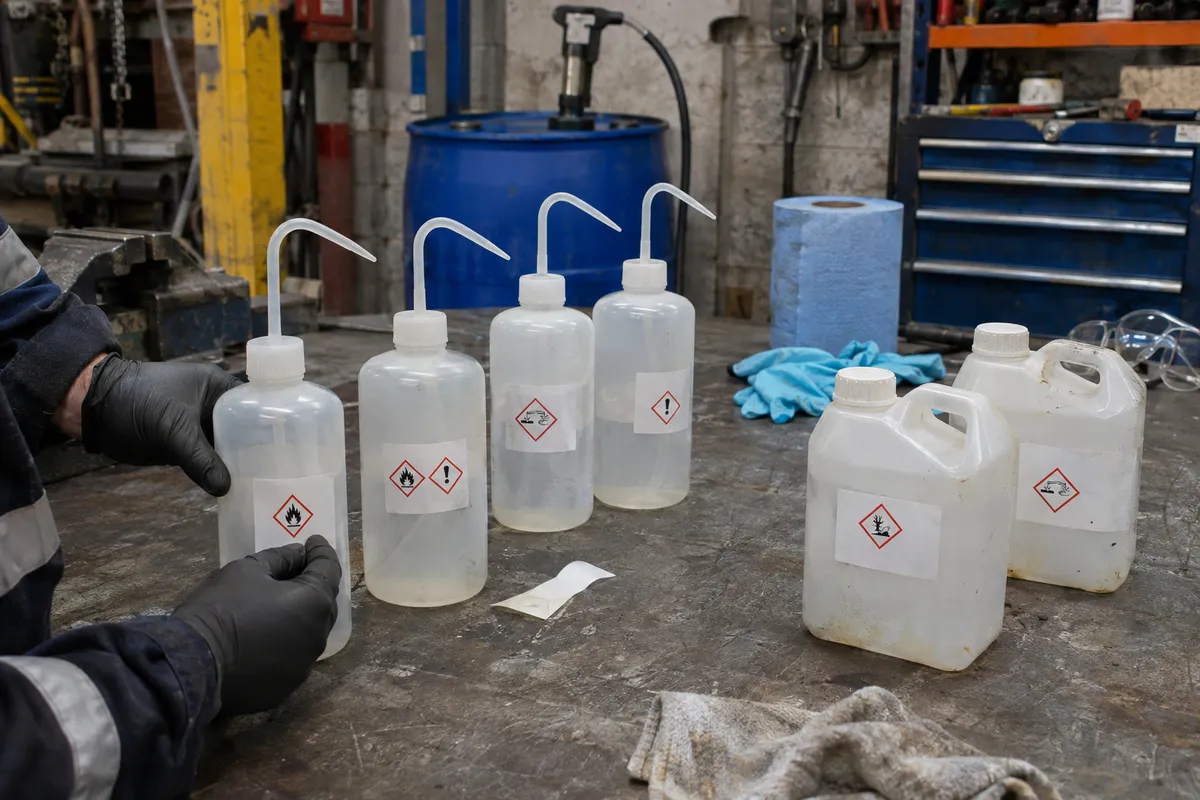
The 200-litre drum arrives with a perfect CLP label. An hour later its contents are spread across six one-litre wash bottles, most of them marked in felt pen: "IPA". That is where most audit findings come from: not the supplier's packaging, but the containers a site fills itself.
Two sets of rules, two situations
- CLP governs the supply label: what a manufacturer or distributor puts on the packaging they sell. In Great Britain this is GB CLP, the retained version of Regulation (EC) 1272/2008; Northern Ireland follows EU CLP. EU amendments adopted after Brexit do not automatically apply in Great Britain.
- The Health and Safety (Safety Signs and Signals) Regulations 1996, Schedule 1 Part III, cover containers used at work, storage containers and visible pipework. HSE's guidance on them is L64.
So the supplier's drum is a CLP matter. The wash bottle you fill on the shop floor is a safety-signs matter, alongside your COSHH assessment.
What a workplace container must show
Schedule 1 Part III says containers used at work for hazardous chemicals, storage containers and visible pipes must be labelled with the relevant hazard pictograms in line with CLP. The label:
- may be supplemented with the name and/or formula of the substance and details of the hazard;
- may be replaced by a warning sign (the yellow triangle) using the same pictogram or symbol.
The requirement does not apply to containers used at work for brief periods, nor to containers whose contents change frequently, provided alternative adequate measures, in particular information and/or training, give the same level of protection. A beaker filled for a ten-minute job can qualify. A wash bottle that sits on the bench all week does not.
The safest habit is to copy the key elements of the original label: product name, pictograms and signal word. Anyone, including a contractor or a firefighter, can then read the hazard without finding the safety data sheet. Each symbol is explained in our post on hazard pictograms.
Pipework and stores
On pipes, labels go near the most dangerous points, such as valves and joints, and at reasonable intervals. One label where the line starts is not enough. HSE has also pointed out that the duty to sign follows the risk assessment, so not every visible pipe needs a label; but where one is needed, it belongs at the valves.
Areas holding significant quantities of hazardous substances are marked with a warning sign or a label near the store or on its door, unless the labels on the individual containers already do the job.
Signs must be fixed to the visible side(s) in unpliable, self-adhesive or painted form. Masking tape and marker pen is none of those.
How big should the label and pictogram be?
CLP's minimum sizes (Annex I, Table 1.3) are written for supply labels, but they are a sound benchmark for your own containers:
| Capacity | Label (mm) | Pictogram (mm) |
|---|---|---|
| up to 3 l | if possible at least 52 × 74 | at least 10 × 10, if possible 16 × 16 |
| over 3 to 50 l | at least 74 × 105 | at least 23 × 23 |
| over 50 to 500 l | at least 105 × 148 | at least 32 × 32 |
| over 500 l | at least 148 × 210 | at least 46 × 46 |
Each pictogram covers at least one fifteenth of the minimum label area set aside for the required information, and never less than 1 cm². It is a square set on its point: black symbol, white background, red frame wide enough to be clearly visible.
If you buy from EU suppliers: Regulation (EU) 2024/2865 added formatting rules for EU labels (minimum font size, line spacing, colour), and Regulation (EU) 2025/2439 pushed their application back to 1 January 2028.
Worked example: isopropanol from drum to wash bottle
A common case in electronics and maintenance: propan-2-ol (isopropyl alcohol, IPA) decanted from a 200 l drum into 1 l wash bottles. Its harmonised classification: Flam. Liq. 2 (H225), Eye Irrit. 2 (H319), STOT SE 3 (H336).
A robust wash-bottle label carries:
- Propan-2-ol (isopropyl alcohol), in large type;
- GHS02 (flame) and GHS07 (exclamation mark), each at least 16 × 16 mm;
- the signal word Danger;
- H225 "Highly flammable liquid and vapour", H319 "Causes serious eye irritation", H336 "May cause drowsiness or dizziness";
- optionally the department or an internal code.
Size 52 × 74 mm, stuck on the body of the bottle, not the cap: caps get swapped. The original drum keeps its supplier label until it has been cleaned.
The material is where labels fail
- Chemical resistance. IPA, acetone and degreasers dissolve felt-pen ink and soften many papers. A synthetic face stock (polypropylene or polyester) printed thermal transfer with a resin ribbon generally holds up far better than direct thermal paper, which also darkens with heat. Always test with your own chemical: a drop, a rub with a cloth, leave it overnight.
- Adhesive. Jerrycans and wash bottles are usually polyethylene, a low-surface-energy plastic that standard adhesive struggles to grip. Tell your supplier.
- The red frame. Label printers print one colour. The usual answer is rolls with the red diamond frame pre-printed, so your printer adds the black symbol, name and statements on site. More on face stocks: paper, PP or polyester.
Mistakes we see again and again
- Marker pen on masking tape: unreadable after the first solvent splash.
- Old label left on a reused container next to the new one.
- Drinks bottles used as containers.
- Label on the cap only.
- Pictograms printed with a black frame, or shrunk to a few millimetres.
- Pipework marked once, nowhere near the valves.
Checklist
| Question | What to check |
|---|---|
| Is the container used beyond one short task? | Then it needs a label |
| Does the name lead to the SDS? | Same name as the original pack |
| Pictograms complete, with red frames? | Compare with the supplier label |
| Does the label survive the chemical? | Drop and rub test |
| On the body of the container? | Not on the cap |
| Pipework? | At valves and joints, repeated |
What to tell your label supplier
- which chemicals and temperatures will reach the label;
- container material (HDPE, PP, glass, metal);
- label size, labels per roll, core size, printer model;
- whether you want rolls with pre-printed red frames to finish on site, or fully printed labels.
Our warning and safety labels come as standard designs and custom print. For regular volumes, printed roll labels can carry your frames and pictograms on paper, PP or polyester. To print in-house on a plastic face, see our polypropylene thermal labels.
This article summarises the rules cited as of its date; always check the current text and your COSHH or health and safety adviser.
FAQ
Do decanted chemicals need a label?
Yes, if the container is used beyond a brief task. The Safety Signs and Signals Regulations exempt only containers used for brief periods or whose contents change frequently, and only where information and training give the same protection.
What should a secondary container label include?
At minimum the relevant hazard pictograms. Adding the product name and signal word from the supplier label is good practice and links the container to its safety data sheet.
Does the pictogram frame have to be red?
Under CLP, yes: black symbol on white with a red frame. With single-colour printers, use labels with the frame pre-printed.
Which label survives acetone or IPA?
Usually a synthetic face stock (PP or polyester) printed with a resin ribbon. No label resists everything, so test with your own chemical.
Are COSHH labels a legal term?
No. 'COSHH labels' usually means workplace hazard labels. The labelling duty for workplace containers comes from the Safety Signs and Signals Regulations 1996, while COSHH covers the wider risk assessment and information to staff.