Ordering labels with your own design: the brief a printer needs from you
A label quote is only as good as the brief behind it. The ten points to settle before you contact a printer, what drives the price and the artwork mistakes that hold up an order.
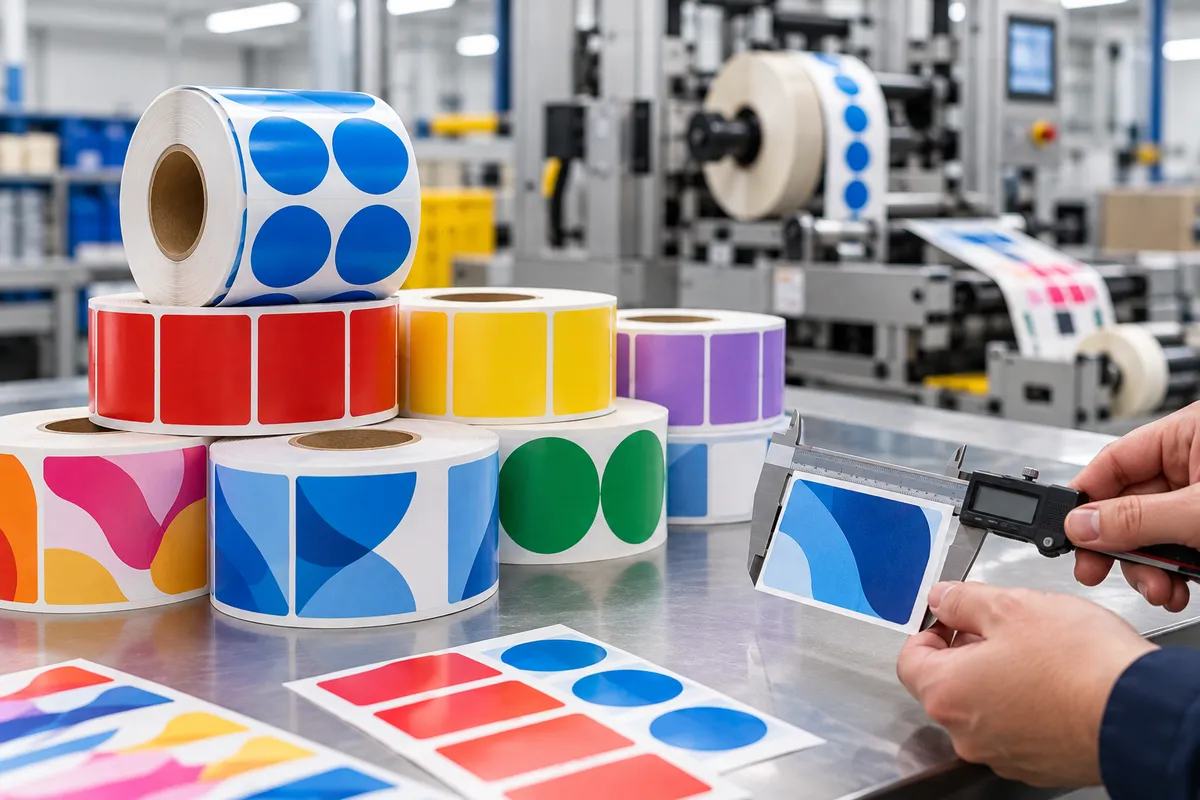
A label quote is only as accurate as the brief behind it. A vague request gets a rough price, a string of emails and sometimes labels that don't suit the machine. These are the points to settle before you contact a printer.
1. Size, measured on the product
Measure the space available on the pack, not the label you'd like. Leave a few millimetres of margin and check curved surfaces: on a tapered bottle, a large rectangle will crease. A standard size is often cheaper than one that needs a new cutting die.
2. Material
- Paper for dry products;
- polypropylene for damp, cold or handling, in white, clear or matt silver (Silvermat);
- polyester for heat, solvents and long life.
The details are in our comparison of paper, PP and polyester.
3. Adhesive
Permanent in most cases, removable on request, or suited to cold conditions. State the surface (board, glass, polyethylene, metal) and the temperature at application.
4. Colours and print
We print multi-colour UV flexo. Say whether brand colours must be matched (Pantone reference), whether a clear label needs a white underprint, and whether there is variable data: sequential numbering, batch, date. Numbered labels are part of what we produce.
5. Artwork
- vector PDF, text converted to outlines, images at 300 dpi at actual size;
- bleed and safe area as the printer specifies;
- barcodes generated as vectors and at a readable size (see how small a barcode can be).
The most common mistake: a low-resolution logo taken from a website.
6. Quantities and versions
Give the quantity per version: 10,000 labels of one design are priced differently from 10 × 1,000 for ten flavours. Your annual usage helps too, so the right run length can be suggested.
7. Roll finishing
- core (25, 40 or 76 mm) and maximum outside diameter;
- labels per roll;
- hand application or applicator, and for an applicator the wind direction, with a sketch.
All three are explained in label core and winding.
8. Regulatory requirements
Mandatory food information, hazard pictograms, machinery marking: they set the minimum space and sometimes the type size. Plan them before the design, not after.
9. Proof approval
Approve a proof before production: text, colours, direction, a scanned barcode. It's the last point at which a correction costs nothing.
10. Delivery
Address, target date, receiving constraints (loading bay, hours). We deliver across Europe and to the UK.
What drives the price
| Factor | Effect |
|---|---|
| Quantity per version | The longer the run, the lower the unit price |
| Number of versions | Each design adds make-ready |
| Material | Paper < PP < polyester |
| Size and die | An existing size avoids a new die |
| Colours and options | White underprint, variable data |
The ideal brief in one line
"3 versions × 5,000 labels, 60 × 40 mm, white PP, permanent adhesive for a PE bottle, 4 colours, 76 mm core, wind direction 3 for an applicator, delivery to Leeds."
Send us your brief through the quote form: we reply by email within 12 working hours.
FAQ
What artwork files do you need?
A vector PDF with text outlined, images at 300 dpi at actual size, and bleed and safe area as we specify.
Why give the quantity per version?
Each design has its own make-ready: 10,000 identical labels cost differently from ten versions of 1,000.
Can labels be numbered?
Yes, we produce labels with sequential numbering.
Is removable adhesive possible?
Yes, on request. Tell us the surface and how the label is used.
How quickly will I get a quote?
We reply by email within 12 working hours of receiving a complete brief.